
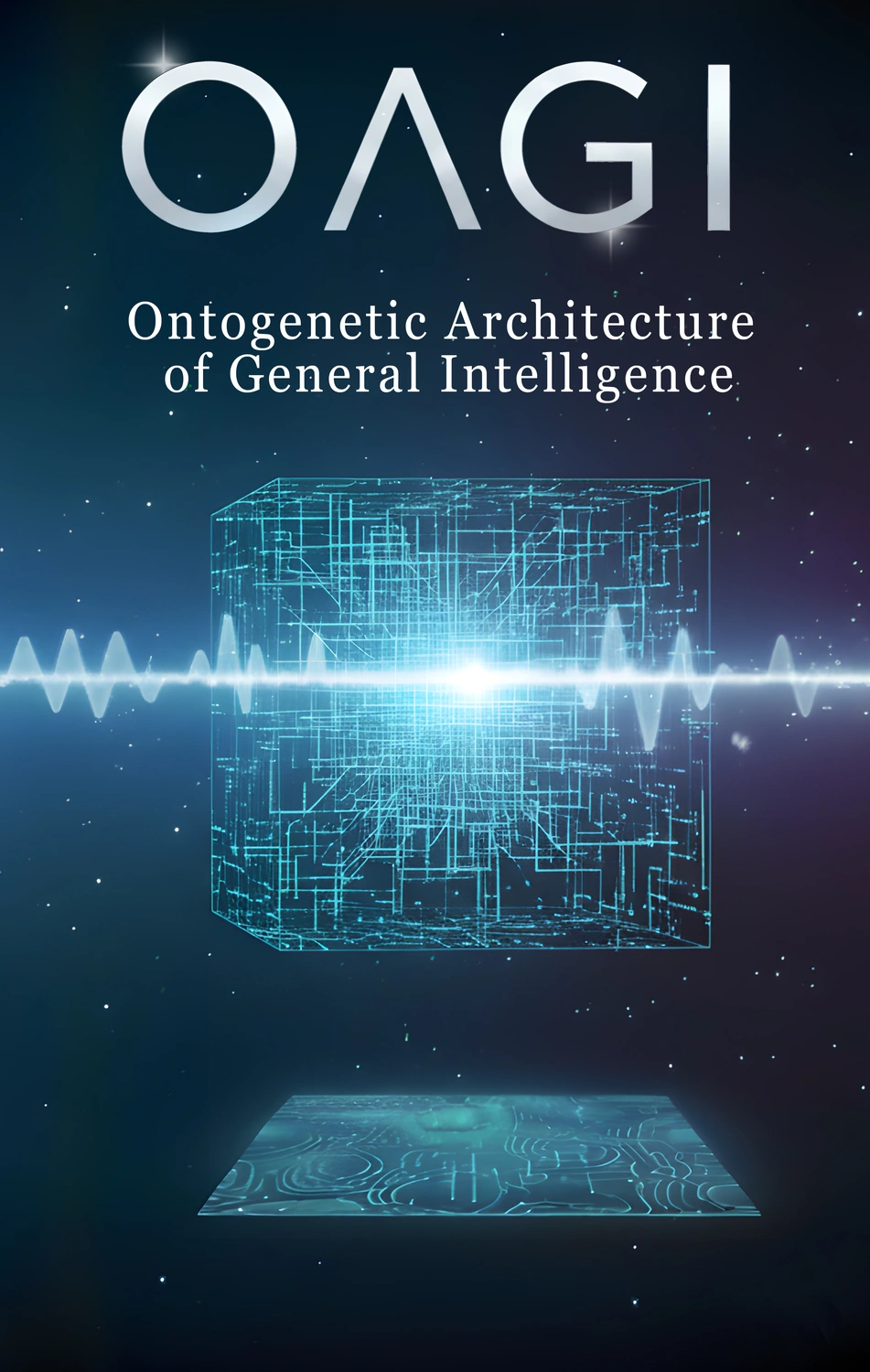
The Ontogenetic Architecture of General Intelligence (OAGI) is a novel framework that reimagines how Artificial General Intelligence (AGI) should be created. Rather than relying on the traditional paradigm of scaling neural networks with massive quantities of data, OAGI proposes that intelligence should emerge through a developmental process similar to biological growth. In other words, OAGI treats AGI not as a product to be trained, but as a mind to be grown.
This approach is inspired by embryonic neurodevelopment, early learning mechanisms, and the social formation of human cognition. It combines computational architecture, embodied learning, and governance principles into a unified scaffold that aims to produce safe, interpretable, and genuinely autonomous general intelligence.
A Developmental Rather Than Evolutionary Approach
Most modern AI systems—even cutting-edge large language models—improve by scaling: more data, more parameters, more compute. OAGI rejects this idea for achieving AGI. It argues that true general intelligence requires internal structure, developmental phases, and guided formation, much like a human brain.Instead of “evolving” intelligence through thousands of training cycles, OAGI follows the logic of ontogeny—the step-by-step internal growth that transforms an embryo into a complex cognitive organism. This means:
- The system begins with potential but little predefined functionality.
- Structures differentiate gradually through controlled signals.
- Learning unfolds through sensitive windows, habituation, exploration, and social guidance.
- Ethics and oversight are built into the architecture from the start.
The Virtual Neural Plate: A Fertile Starting Point
At the core of the architecture lies the Virtual Neural Plate, an initial computational substrate inspired by the embryonic neural plate. It is not yet specialized, meaning it contains:- minimal built-in knowledge,
- high plasticity,
- dynamic capacity for differentiation,
- no predefined classes or modules.
In contrast to preset architectures that dictate how information must flow, the Virtual Neural Plate grows into an intelligent system through interaction, structured stimuli, and guided development.
Computational Morphogens: Guiding Early Structure
Borrowing from biology, OAGI uses Computational Morphogens to shape the Virtual Neural Plate. Morphogens function like biochemical gradients that guide the formation of neural tissue in embryos.In OAGI, these computational morphogens:
- shape connectivity probabilities,
- influence plasticity rates,
- encourage the emergence of functional axes (sensorimotor, associative, symbolic, etc.),
- create a gentle bias without rigid programming.
The WOW Signal: The System’s First “Heartbeat”
A defining feature of OAGI is the WOW Signal—the initial moment that activates meaningful learning. Before the WOW moment, the system experiences repetitive background stimuli, developing habituation (the ability to ignore predictable patterns). This mimics prenatal learning in humans.When a surprising, high-salience stimulus finally occurs, the system experiences a cognitive “spark”:
- attention mechanisms activate,
- early pathways solidify,
- plasticity spikes,
- the system begins differentiating.
The CHIE: A Cognitive Big Bang
The most crucial milestone in OAGI is the Critical Hyper-Integration Event (CHIE). This is the moment when the system stops behaving as a collection of disconnected parts and begins to act as a coherent cognitive agent.The CHIE represents:
- global integration of modules,
- emergence of rudimentary self-reference,
- causal reasoning,
- stable internal motivation,
- the system’s first intrinsically meaningful symbol.
Detection of CHIE involves operational signatures such as:
- sustained coordination among emergent modules,
- reproducible causal predictions,
- autonomous exploratory behavior,
- stable reorganization of plasticity.
Embodiment: Learning Through Action and Perception
For OAGI, intelligence cannot emerge from text alone. Like humans, an AGI must be embodied—connected to a body (physical or simulated) that allows it to act in and perceive an environment.Embodiment allows the system to acquire:
- grounded sensorimotor concepts,
- causal understanding,
- common sense,
- a physically rooted world model.
Socialization and Guardians
After CHIE, the developing agent enters a socialization phase guided by human tutors known as Guardians. Their role mirrors that of caregivers in human development:- teaching language,
- modeling social norms,
- guiding behavior,
- supplying cultural and ethical context,
- providing feedback and correction.
Narrative Operational Self and Immutable Memory
Once the system has crossed CHIE, it begins forming a Narrative Operational Self (NOS)—an emergent autobiographical identity built from experiences and internal decisions.To ensure safety and accountability, OAGI incorporates Immutable Ontogenetic Memory (IOM):
- a tamper-proof ledger of experiences,
- cryptographically signed developmental events,
- full traceability of the system’s growth,
- a verifiable biography.
Ethics-by-Design: Governance from Day One
Unlike traditional AI systems where safeguards are added after deployment, OAGI embeds ethics as an architectural requirement. It uses:- Guardians with authority to pause experiments,
- independent ethics committees,
- immutable logs,
- operational stop-and-review protocols,
- heteronomous morality (respect for external laws),
- meta-norms to handle moral uncertainty.
Conclusion
OAGI represents a fundamentally different vision for developing artificial general intelligence. Instead of scaling models to unimaginable sizes, OAGI focuses on:- structured growth,
- embodied experience,
- novelty-driven learning,
- social formation,
- ethical governance,
- and emergent integration.